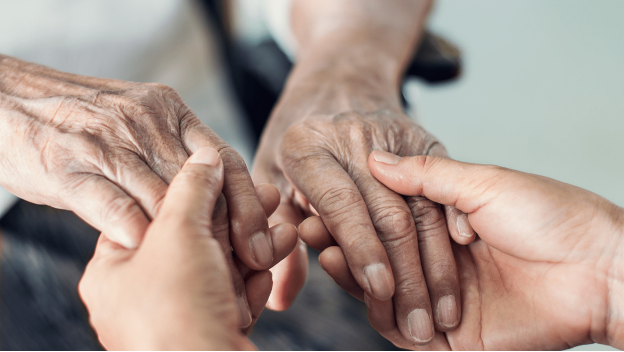
There are many things you can say about what meditation is. A technique for clearing and calming the mind, a spiritual discipline, a method of stress reduction, a type of prayer, a way of coming into alignment with reality, to name just a few. One way of thinking about meditation that I’ve been contemplating recently is that it is an expression of care.
When we sit with ourselves and try to be present in each moment, we are saying, “I care about this moment. I care about how things are in my experience.” Most of the time we are going about the tasks of daily living, completing the items on our to-do lists, or chasing the shiny objects of our desires and fears, whether that’s doomscrolling on social media or browsing for cool artisanal chocolate at the local specialty store, or fantasizing about what’s next. And in each moment that we let go of those things and return to our present moment experience of body, mind, and heart, we are returning to that expression of care.
With all the focus on external things, on doing and achieving and caring for others, it’s easy to lose touch with how things are internally for ourselves, in our direct experience of body and mind. In meditation, we just sit with ourselves as we are. This gives us a chance to focus on what’s essential – the fact that we are living, breathing, feeling and aware beings. Shiny objects might arise for us, but in meditation they are only mental experiences; when we think about that great artisanal chocolate during meditation we don’t leap off the cushion and head to the store to buy some. (Well, we could if we wanted to. But usually that doesn’t happen!) Instead we observe the desire, feel it, experience it. But we don’t get lost in it. We do, however, care about it. We care that this is our mental experience right now; this is where the heart and mind is. Without judging ourselves, we can reflect on why that might be right now. Every moment we are being present with our desires or fears or confusions instead of getting lost in them is a moment we are expressing care about what’s happening in the mind. And if we observe the desires or fears or confusions long enough, our relationship with them can begin to change. We don’t believe them so much, we are not so caught up in their trance, and the stress they can cause us lessens. This is the beauty and promise of meditation. It shows us how caring about our experience is also a path to healing.
Think about the body in meditation and consider the idea of feedback. When things go wrong in a system a working feedback loop reports data back to the control center so that adjustments can be made and equilibrium is maintained. Human beings are systems too, but we often have broken feedback loops. Our minds go astray, tension builds up in the body, and stress can become toxic. We are conditioned to think externally, to grasp after those shiny objects rather than paying attention to ourselves. This is why when we’re stressed it may take us a long time to realize it. And that can have negative, even disastrous, consequences. But meditation helps us close the feedback loop. When we notice that the breath is tight in the chest, we mindfully acknowledge it and stay with it, even though it’s hard to stay with the breath when it’s uncomfortable. In the next moment, we come back to the breath and notice the discomfort again. Moment by moment we build a steady, gentle, caring awareness of our tight breathing. We may get distracted because it’s hard to be with the discomfort. But we return to the breath over and over because we care. And of course this applies to any other difficulties we may be having in our lives. What’s important to remember is that it’s the choice to care about the difficult experience, to be present for it, to return to it, that makes all the difference. Many times in my life I stayed with my breathing when it was difficult, and many times the breath became softer and easier as a result, leading to my own healing.
Meditation is an essential way of resisting the daily habit of avoiding ourselves. We are indoctrinated to stay busy, to “be productive,” to avoid paying attention to ourselves because it’s considered selfish. That notion is the exact opposite of caring for ourselves – to make sure we rest when we need to, turn inward, and close the feedback loop to notice how we are physically, mentally, emotionally, and spiritually, helping us do what we need to do to heal. With this self care established as a foundation, we can more sustainably serve others.
To meditate is to care, and caring is something we can choose to do in any moment.





 Perhaps the most fundamental fact of our aliveness is that from the moment of our birth to the moment of our death, we are breathing. Yet strangely enough, we routinely take the breath for granted and forget about it. Our attention instead is gripped by our to-do lists, our racing thoughts of gain and loss, our interactions with the world. Many people I’ve worked with over the years, when describing a stressful situation, cannot recall at all how their breath felt during the event. The fact is, the breath is a vital ally in the practice of mindfulness. Because it is always available, and because its shifting nature reflects our moment to moment state of being, the breath is our portal to understanding, healing and well-being.





 What do you have a hard time letting go of? Perhaps it’s letting go of the little time-honored personal rituals that you enact in your life. Like always grating your cheese or chopping onions a certain way. Or always listening to a certain program or reading certain publications to get on top of current events. Or making sure you always get to a movie early enough to watch the trailers. Or perhaps it’s the idea that you always need to be the best at something, the smartest person in the room? Or that you always need to be right? Or that your body should always look a certain way? Or that only certain people are worthy of your consideration? Maybe it’s hard to give up a plan, or an ideal, or a relationship. But think about this. When we talk about letting go, what exactly are we letting go of? What’s behind the letting go of, say, the idea that you always need to be right, or chop your onions in a certain way?
 I had been looking forward to celebrating the end of the year and the start of 2017 at a party with my partner and some friends. Instead, I spent the day in bed, swamped with fever and chills, tormented by an incessantly dripping nose and a vicious hacking cough. I was sick for about 6 days overall (and in fact am still recovering). While that is not that long of an illness it did provide me with plenty of time to contemplate the nature of healing, and the relationship between physical and mental wellness.
 If you practice mindfulness meditation, you’ve had this experience: you are focusing on your breath, one inhale and exhale at a time, when suddenly a compelling thought arises, distracting you. Maybe the thought is about work, or a relationship, or the vacation that starts next week, or whatever. That thought then leads you down a series of mental rabbit holes until – five minutes in – you realize that you’ve completely lost the breath. It can be humbling to realize how little control we have over our minds. Those thoughts are so compelling!